Photo Gallery
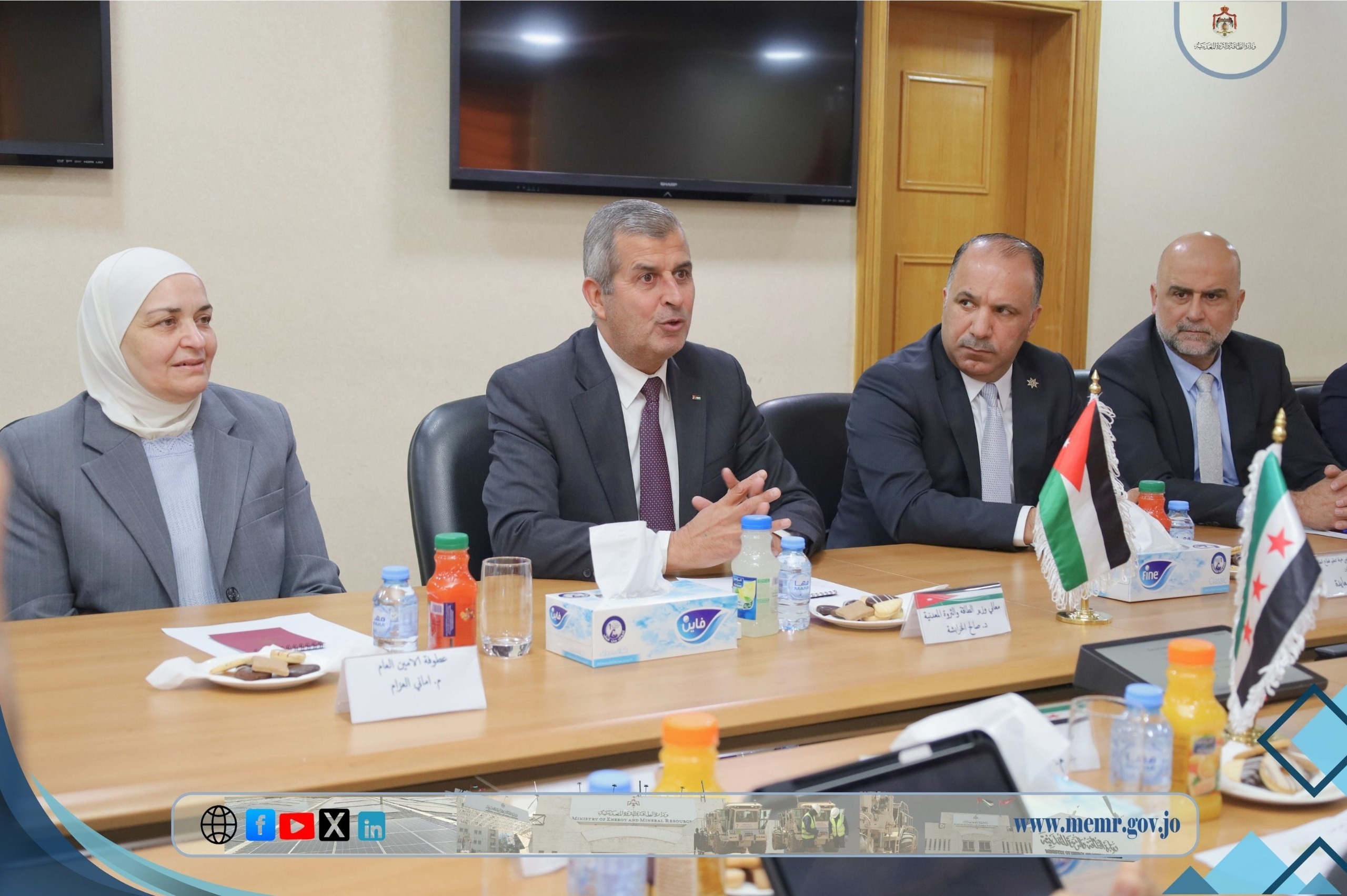
November 20, 2025 — Trilateral cooperation meetings between Jordan, Syria, and Lebanon were held in the capital, Amman, on Thursday to discuss projects in the electricity and gas sectors. The meetings were attended by Jordan’s Minister of Energy and Mineral Resources, Dr. Saleh Al-Kharabsheh; Lebanon’s Minister of Energy and Water, Joe Saddi; and Syria’s Minister of Energy, Eng. Mohammad Al-Bashir, along with technical and engineering delegations from the three countries.
The meetings included discussions on the need to conduct a technical assessment of the infrastructure of electricity interconnection lines and gas transmission pipelines on the Syrian and Lebanese sides, while emphasizing Jordan’s readiness to supply Lebanon and Syria with part of their energy needs.
The three ministers agreed to form joint technical teams to assess and upgrade the lines in a manner that serves the interests of all parties, and to develop a matrix of required procedures to be followed up by the relevant stakeholders.
The meetings aimed to strengthen Arab and regional cooperation in the energy sector by reactivating electricity interconnection projects, resuming gas pumping through the Arab Gas Pipeline, and enhancing joint efforts to improve energy system efficiency and supply reliability among the three countries.
On the sidelines of the meeting, Dr. Al-Kharabsheh stated that Jordan believes in the importance of raising levels of cooperation among the three countries across various energy projects, addressing challenges, and overcoming obstacles to achieve shared interests.
He explained that the meeting seeks to capitalize on the significant joint opportunities in electricity and gas interconnection projects, in cooperation and coordination with donor institutions such as the Arab Fund for Economic and Social Development and the World Bank, stressing Jordan’s determination to maximize available opportunities and advance cooperation.
For his part, Syrian Minister of Energy Eng. Mohammad Al-Bashir said that Syria’s important geographical location as a key connection point between Jordan and Lebanon for electricity transmission lines and the Arab Gas Pipeline requires continuous coordination with neighboring countries to rehabilitate and restore these lines to operation, in line with required technical specifications and standards, after being affected by political conditions.
Al-Bashir noted that technical teams are working intensively to rehabilitate and upgrade electricity interconnection lines and overcome certain challenges facing the Arab Gas Pipeline on the Lebanese side, pointing out that the interconnection with Jordan enjoys a high level of readiness.
Meanwhile, Lebanese Minister of Energy and Water Joe Saddi said that the meeting comes within the framework of sustaining communication and cooperation with neighboring countries, explaining that interconnection projects serve the interests of all countries involved.
Saddi added that gas and electricity interconnection projects are essential and vital for the participating countries, contributing to enhance Arab cooperation and paving the way for greater openness to other economic projects in the future.
Jordan had previously affirmed its readiness to supply Lebanon and Syria with part of their energy needs once the required arrangements are completed, particularly regarding the technical condition of the Syrian networks, which suffered damage during the war.
Electricity interconnection projects between Jordan and Syria date back to 2001, before being suspended in 2012 due to political circumstances. In 2022, the three countries signed several agreements to activate the supply of electricity and gas to Lebanon via Syrian territory; however, the project faced challenges related to financing conditions.
The three countries hope that these meetings will contribute to reviving joint interconnection projects and strengthening integration in the energy sector, providing sustainable energy solutions and supporting economic stability and vital services.Top of Form