Photo album
- Al-Kharabsheh Sponsors Launch of Renewable Energy and Energy Efficiency Fund’s “A Decade of Achievement” Report
- More than 2.2 million beneficiaries over a decade, with Fund programs generating energy bill savings exceeding JD 152.9 million
- Fund programs reached nearly one-fifth of the Kingdom’s population and reduced carbon emissions by approximately 883,000 tonnes
10 August 2026 – The Renewable Energy and Energy Efficiency Fund’s “A Decade of Achievement” report has revealed that the Fund’s programs and projects implemented during the period 2015–2025 generated a significant development impact. A total of 2,288,646 citizens benefited from energy efficiency and renewable energy projects, equivalent to 19.2% of the Kingdom’s population. The programs also generated cumulative savings on consumers’ energy bills amounting to approximately JD 152.9 million, while reducing carbon dioxide emissions by approximately 883,270 tonnes.
The report showed that the Fund’s projects and programs contributed to reducing energy consumption by approximately 817.6 gigawatt/hours (gw/h), while the cumulative electricity generation capacity of photovoltaic (PV) systems reached approximately 681.6 gw/h, contributing to enhanced energy security, improved energy efficiency, and the Kingdom’s transition towards a green economy, reduced emissions and sustainable development.
This was announced during a ceremony held today, Monday, under the patronage of Minister of Energy and Mineral Resources and Chairman of the Board of Directors of the Renewable Energy and Energy Efficiency Fund, Dr. Saleh Al-Kharabsheh, to launch the Fund’s achievements report entitled “A Decade of Achievement.” The report documents the Fund’s journey over the period 2015–2025 and presents its strategic vision through 2030, in cooperation with the United Nations Development Program (UNDP) in Jordan.
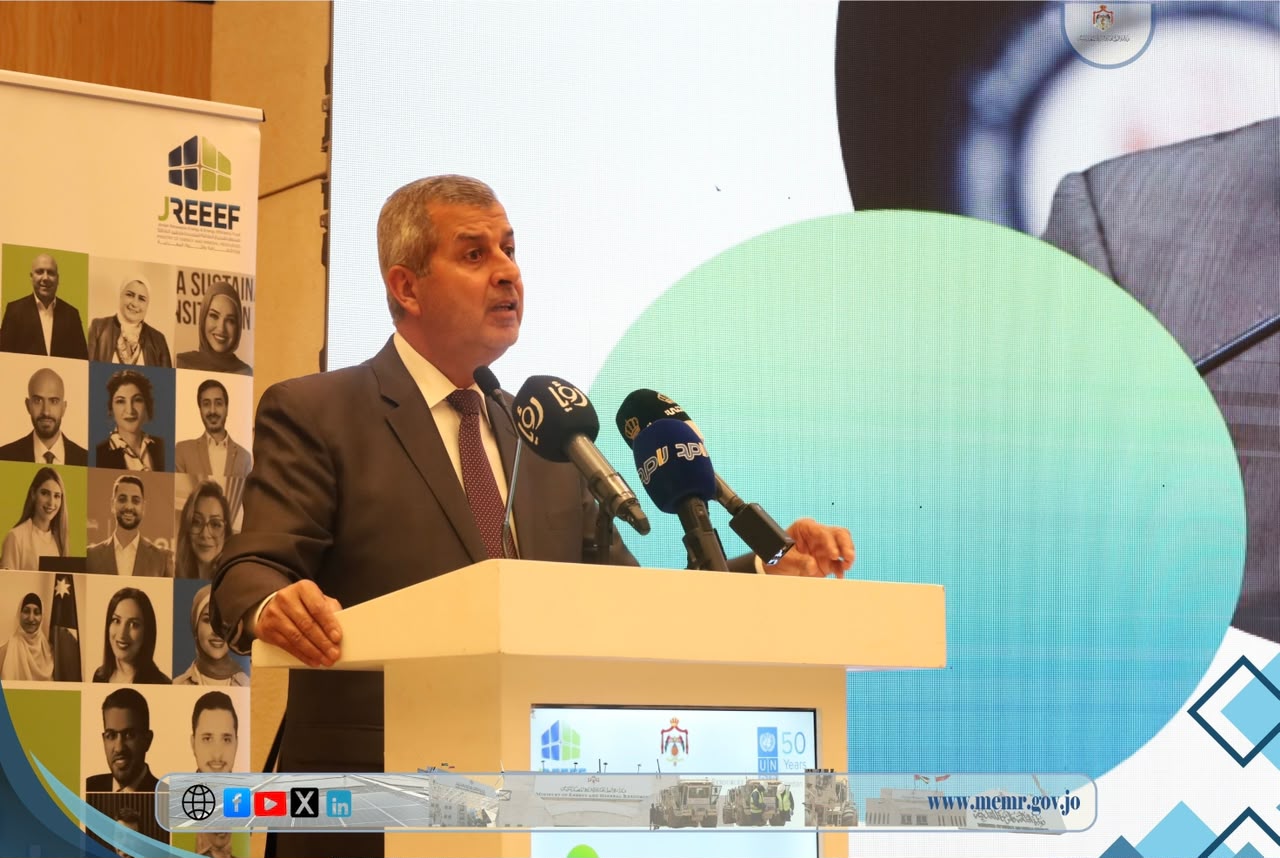
Speaking at the ceremony, Al-Kharabsheh said that the figures reflect the scale of the impact achieved by the Renewable Energy and Energy Efficiency Fund during the period 2015–2025. He noted that the Fund’s programs and projects benefited the equivalent of 19.2% of the Kingdom’s population, while its projects generated cumulative savings estimated at approximately JD 152.9 million on consumers’ energy bills and contributed to reducing carbon dioxide emissions by approximately 883,000 tonnes. He added that these achievements contributed to meeting 7.8% of the Kingdom’s 2030 emissions-reduction target, as well as 7.6% of the total number of solar water heaters installed in Jordan, underscoring the Fund’s pivotal role in supporting energy security and achieving sustainable development objectives.
Al-Kharabsheh said that the Kingdom is working to achieve its strategic objective of energy security, noting that the Fund has become a national platform bringing together the government and national and international donors to support renewable energy and energy efficiency programs and projects. This contributes to advancing the Kingdom’s energy transition, developing the energy services market, empowering the private sector, and developing technical specifications and standards in ways that enhance the sector’s competitiveness and sustainability.
For his part, Executive Director of the Renewable Energy and Energy Efficiency Fund, Rasmi Hamza, said that over the course of 11 years, the Fund had achieved a tangible impact on the lives of citizens and institutions, reaching more than two million beneficiaries across the Kingdom’s governorates.
Hamza said that the Fund’s journey began in 2012 with a legislative framework and an ambitious national vision, while its operations were launched on the ground in 2015, with the objective of supporting the transition towards renewable energy use and improving energy efficiency across various sectors. He added that the Fund was not merely an addition to the state’s institutional structure, but rather a response to a national need based on the recognition that energy is a fundamental component of citizens’ lives, closely linked to improving living standards, enhancing the competitiveness of economic sectors and supporting sustainable development.
He pointed out that the Fund’s programs and projects extended to households, schools, hospitals, farms, industrial facilities, hotels, accommodation facilities and places of worship. These initiatives contributed to reducing energy costs, improving energy efficiency and generating economic savings, while also reducing carbon emissions.
Hamza noted that the impact of the programs should not be measured solely by the number of projects and beneficiaries, but also by the tangible changes, they have brought about in beneficiaries’ lives. He highlighted examples of households that succeeded in reducing their energy costs; farmers whose ability to continue operating and producing was strengthened through renewable energy projects; and educational and healthcare institutions whose working environments and services were improved. The programs also contributed to enhancing the competitiveness of industrial and tourism facilities and creating new opportunities for young people.
Hamza commended the efforts of the Fund’s partners from the private sector, donor organizations, and national and international institutions, as well as the staff of the Ministry of Energy and Mineral Resources and the Renewable Energy and Energy Efficiency Fund, for their role in achieving these accomplishments. He affirmed that the next phase would focus on continuing efforts to expand access to renewable energy and energy efficiency programs, thereby reaching more households, institutions and productive sectors and transforming energy into greater economic, social and development opportunities.
The report indicated that the Fund contributed to expanding the deployment of renewable energy solutions across the Kingdom’s governorates. A total of 13,748 renewable energy systems and 45,298 solar water heaters were installed for households, while the Fund’s contribution represented approximately 7.6% of the total number of solar water heaters installed in Jordan by the end of 2026.
The Fund’s programs also supported improved energy efficiency across economic and service sectors. 162 facilities implemented energy efficiency solutions, while 1,098 facilities implemented renewable energy solutions. The total installed capacity of the photovoltaic systems implemented under these programs reached 69.3 megawatts (mw).
Regarding financing, the report explained that the Fund developed an integrated financing framework that enabled different groups and sectors to benefit from its support programs through full and partial grants ranging from 10% to 50%, in addition to revolving loans. This contributed to accelerating the adoption of renewable energy and energy efficiency solutions.
The Fund also succeeded in expanding its partnerships with a number of international institutions and organizations, most notably the European Union, the Italian Ministry of the Environment and Energy Security, the United States Agency for International Development (USAID), and the International Union for Conservation of Nature (IUCN). These partnerships contributed to enhancing the sustainability of the programs and expanding their reach across the Kingdom.
The report noted that the Fund’s projects targeted various sectors, including the residential sector, industrial sector, hotels, municipalities, hospitals and health centers, places of worship, humanitarian organizations, and the agricultural sector. These initiatives contributed to reducing energy costs, enhancing the competitiveness of productive sectors, improving the quality of services provided, and consolidating Jordan’s transition towards clean energy.